↳ Installations
Wind Remembers
Installation / Sound / Architecture — 2025
WindFestival / Bewegter Wind Festival, Zierenberg, Germany
The sound of installation
Wind Remembers began as an idea I developed in response to Rumi’s famous opening lines of the Masnavi: ‘Listen to the reed, how it tells a tale, complaining of separations.’ The image of the reed separated from the reed bed became the starting point for my exploration of breath, sound, displacement, belonging, and the relationship between individual and collective experience.
As a flutist, I was particularly interested in the connection between the human breath, the hollow structure of the reed, and the sound of wind. The flute and the ney both transform breath into sound, while the reed itself carries a long cultural history within Iranian music and poetry. From this connection, I developed the idea of a space in which architecture, sound, wind, and listening could come together.
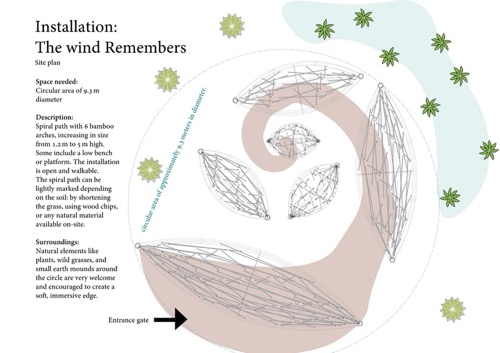
The idea was then developed into a collaborative installation by the Belgian architect Charlotte Dubois, founder of Nest Architecture — a cooperative formed by six people with different backgrounds and lived experiences. It was Charlotte who proposed the spiral form. Together, we translated the initial concept into a pavilion consisting of six bamboo arches. Each arch was built by one member of the group and represents an individual voice or experience. Although each structure remains distinct, the six arches form a single shared space, reflecting the possibility of coexistence without requiring differences to disappear.
The pavilion is organised around a spiral path that leads visitors toward its centre. The work is experienced primarily through listening rather than physical interaction. As visitors move through the structure, the bamboo responds to the movement of air, creating an acoustic environment that changes according to the wind, the architecture, and the presence of people within the space.
The spiral also became a way of thinking about movement, separation, and return. The visitor gradually moves away from the outside world toward the centre of the structure, where they are invited to pause and listen. In this sense, listening becomes a form of participation: the visitor completes the work through their own presence and attention.
The use of bamboo further connects the installation to the original idea of the reed. European-grown bamboo was self-harvested and collectively assembled by the group, allowing the material itself to become part of the conceptual process rather than simply serving as a structural element.
Wind Remembers brings together Iranian poetic and musical references with collaborative architecture and sound. At its core, the work asks how individual voices, experiences, and forms of separation can exist within a shared space, and how listening might create a sense of connection between them.